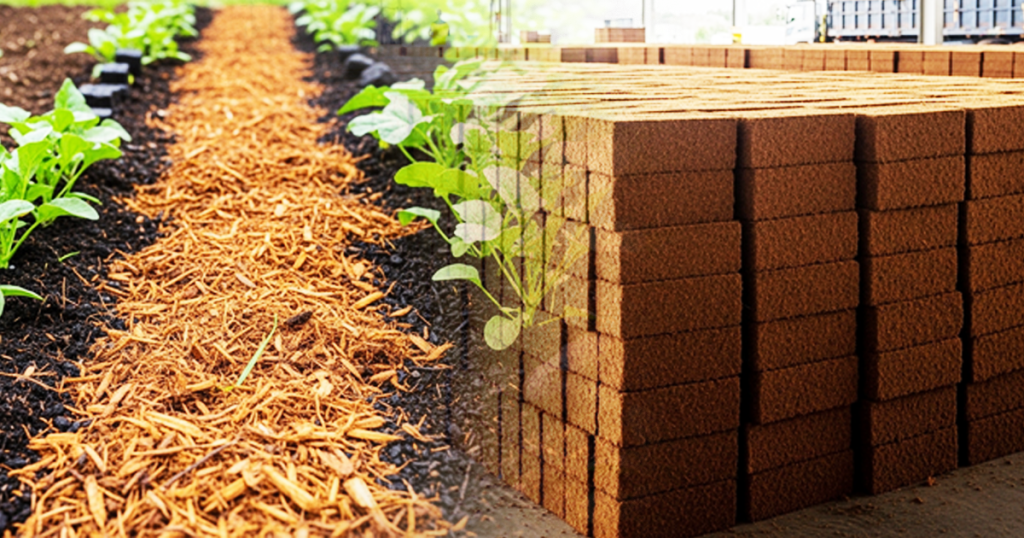
The Rise of Coco Peat: From Waste to Wealth
As global industries shift toward sustainable alternatives, India and Indonesia have emerged as frontrunners in the production of coco peat bricks, an eco-friendly by-product of coconut husk processing.
This trend is not merely an industrial movement but a reflection of growing awareness in sustainable agriculture and environmental conservation. Based on field observations and data analysis, both nations have effectively scaled up their production capacities while enhancing the quality and export readiness of coco peat bricks.
The demand from horticultural markets, especially in Europe and the Middle East, has seen a remarkable rise, pushing innovation and investment in processing technologies across these two countries.
A Natural Substrate for Modern Agriculture
Coco peat, also known as coir pith, is derived from the fibrous husk of coconuts a previously discarded waste now transformed into a valuable growing medium. Rich in lignin and cellulose, coco peat retains water efficiently and provides aeration crucial for root health in hydroponics and greenhouse farming.
India and Indonesia are natural leaders in this domain due to their abundant coconut plantations and relatively low-cost labor. India, especially the states of Tamil Nadu and Kerala, has developed industrial hubs dedicated solely to coir-based exports.
Indonesia follows closely, with Sumatra and Java optimizing their supply chains through smallholder coir cooperatives.
Government Support and Export Boosts
Both governments have recognized the export potential of coco peat bricks. In India, the Coir Board under the Ministry of MSME has been instrumental in funding R&D and offering subsidies to processing units.
Indonesia, on the other hand, is working through public-private partnerships, particularly in collaboration with agricultural cooperatives and foreign investors. According to trade data, India exported over 650,000 metric tonnes of coir products in 2024, with coco peat accounting for 45% of the total.
Indonesia, though behind in volume, has doubled its export revenue from coco peat bricks compared to 2022. These trends signal a strong trajectory for both countries as global suppliers.
Challenges and Innovations in Production
Moisture Control and Compression Standards
Despite their leadership, both nations face technical challenges primarily in moisture content control and standardized compression levels. These factors significantly influence the shelf-life and usability of coco peat bricks in international markets.
Innovations are addressing these issues. In Tamil Nadu, automated sun-drying systems and hydraulic compressing machines are being integrated into medium-scale operations. Indonesian manufacturers are experimenting with bio-degradable packaging and blockchain-based traceability systems to appeal to environmentally conscious buyers.
Environmental and Socioeconomic Impacts
While coco peat is sustainable, its processing involves substantial water use and labor. In response, India and Indonesia have initiated water recycling systems in large factories and ensured fair labor practices through cooperative-based production models. These steps not only protect natural resources but also uplift rural communities dependent on the coconut industry.
Global Market Trends and Future Outlook
Export Trends and Emerging Markets
The coco peat market is forecasted to grow by 6.5% annually until 2030. Apart from traditional markets like the Netherlands and Saudi Arabia, new demand is emerging from South Korea, Japan, and African nations developing urban farming systems. India and Indonesia are adapting quickly, offering customized coco peat blends for different crop and climate needs.
Toward Standardization and Research
One of the pressing needs is international standardization. Both countries are now collaborating with institutions like the International Coir Board and ISO working groups to develop universal quality metrics. Academic research is also intensifying, particularly on nutrient enhancement and pathogen control in coco peat substrates.
As a researcher in this field, I see a clear intersection between science, policy, and market forces shaping this sector. India’s and Indonesia’s leadership is not accidental; it is the result of strategic alignment between natural resource utilization, grassroots entrepreneurship, and forward-thinking governance.