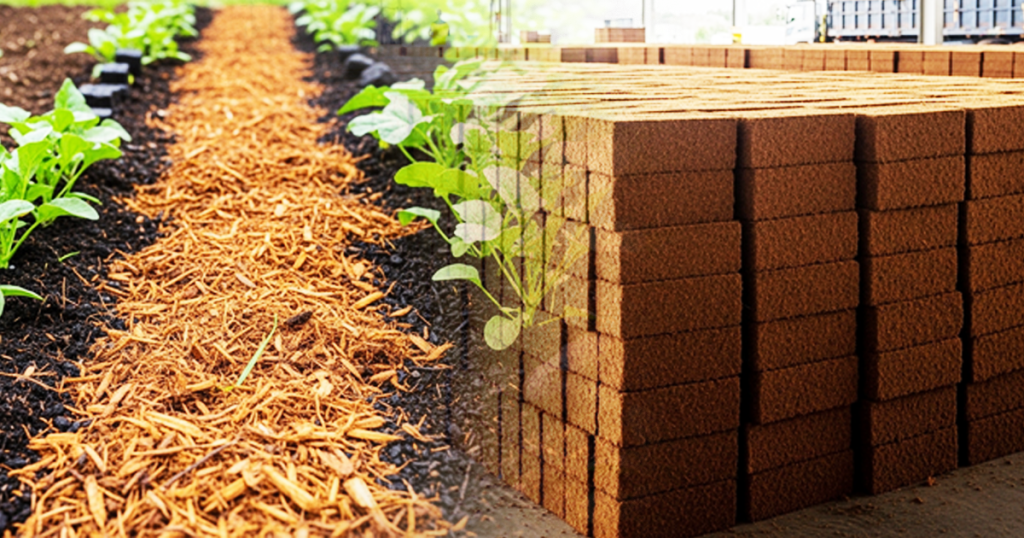
The Shifting Landscape of Agricultural Substrates
In the past decade, modern farming has undergone a paradigm shift. Traditional soil, once considered the irreplaceable foundation of agriculture, now faces strong competition from alternative growing mediums.
Among these, cocopeat a by-product of coconut husk processing has emerged as a sustainable and efficient option. As a researcher specializing in soilless media, I’ve closely examined the performance, sustainability, and productivity of cocopeat compared to conventional soil.
Understanding the Composition and Properties
Cocopeat: A Renewable Marvel
Cocopeat, also known as coir pith, is a spongy, fibrous material with excellent water retention and aeration capabilities. It is renewable, biodegradable, and pH-neutral, making it ideal for precision agriculture and hydroponic systems. Unlike soil, cocopeat is free from weeds, pests, and soil-borne diseases, significantly reducing the need for chemical treatments.
Traditional Soil: The Age-Old Standard
Soil, a complex mixture of organic matter, minerals, water, and air, provides essential nutrients for plant growth. However, soil quality varies greatly depending on geography, climate, and human activity. Soil compaction, erosion, and contamination have become major challenges in conventional farming systems.
Productivity and Plant Growth Performance
Yield Comparisons
Numerous controlled experiments have demonstrated that crops grown in cocopeat often exhibit faster germination, stronger root development, and higher yields. This is due to cocopeat’s superior water-holding capacity and consistent nutrient availability. However, it requires careful monitoring of nutrient input since cocopeat itself contains minimal nutritional content.
In contrast, traditional soil can provide a broader nutrient profile but may suffer from inconsistent water drainage and compaction, leading to root stress and suboptimal plant performance.
Suitability for Different Crops
Cocopeat performs exceptionally well in growing vegetables, herbs, and ornamental plants, particularly in greenhouse environments. Traditional soil, while still effective for large-scale grain production and tree farming, often needs substantial amendment to match the efficiency of soilless systems.
Environmental and Economic Considerations
Sustainability Factor
Cocopeat is a by-product of the coconut industry, utilizing what would otherwise be waste. It promotes circular agriculture and reduces environmental burden. Moreover, it can be reused for multiple cropping cycles after sterilization, enhancing its life-cycle value.
On the other hand, traditional soil usage often involves intensive tillage, chemical inputs, and water overuse, contributing to land degradation and greenhouse gas emissions. Soil restoration requires years, whereas cocopeat-based systems offer quicker regeneration.
Cost Implications
Initial setup for cocopeat systems, including containers and nutrient management infrastructure, can be expensive. However, long-term returns often surpass traditional farming due to reduced pesticide usage, water savings, and higher yields. Traditional soil farming still holds economic appeal in areas with fertile land and low capital investment.
Challenges and Limitations
While cocopeat offers impressive benefits, it is not without drawbacks. Its nutrient deficiency demands precise fertilization. Salinity issues may arise if poorly processed cocopeat is used. In regions lacking coconut production, the import cost can be prohibitive.
Conversely, traditional soil’s reliance on natural cycles and susceptibility to contamination make it unpredictable. Climate change further exacerbates soil-related risks, pressing the need for alternative solutions.
The Verdict: A Contextual Choice
In conclusion, the debate between cocopeat and traditional soil is not about supremacy but suitability. For controlled environment agriculture, urban farming, and high-value crops, cocopeat is a game-changer. For staple crops and large-scale outdoor farming, soil remains essential.
As a researcher, I advocate for integrative models that combine the strengths of both media. The future of farming lies not in choosing one over the other, but in using them synergistically to optimize productivity, sustainability, and resilience.