Revolutionizing Modern Agriculture, One Brick at a Time
In the growing conversation around sustainable farming, coco peat bricks have steadily emerged as an unheralded yet vital component of hydroponic systems. Derived from the fibrous husk of coconuts.
Coco peat also known as coir pith or coir dust was once considered agricultural waste. Today, it stands at the forefront of soilless cultivation, offering an eco-friendly and efficient medium for modern growers.
As a researcher deeply involved in substrate technology, I’ve watched coco peat evolve from a humble byproduct to a cornerstone of clean agriculture. Its unique physical and chemical properties make it a preferred choice in hydroponics, where soil is replaced by inert growing mediums.
What Makes Coco Peat Bricks Ideal for Hydroponics?
Hydroponic farming demands substrates that can retain moisture, provide aeration, and remain pathogen-free. Coco peat bricks, when hydrated, expand into a light, spongy medium that excels in all three.
Coco peat holds up to eight times its weight in water, ensuring that plant roots remain hydrated while avoiding the risk of waterlogging. Its natural porosity improves air circulation, supporting robust root development a key factor in hydroponic yields.
Additionally, unlike peat moss, coco peat is renewable and biodegradable, making it a more sustainable choice.
From Waste to Resource: The Science Behind the Transformation
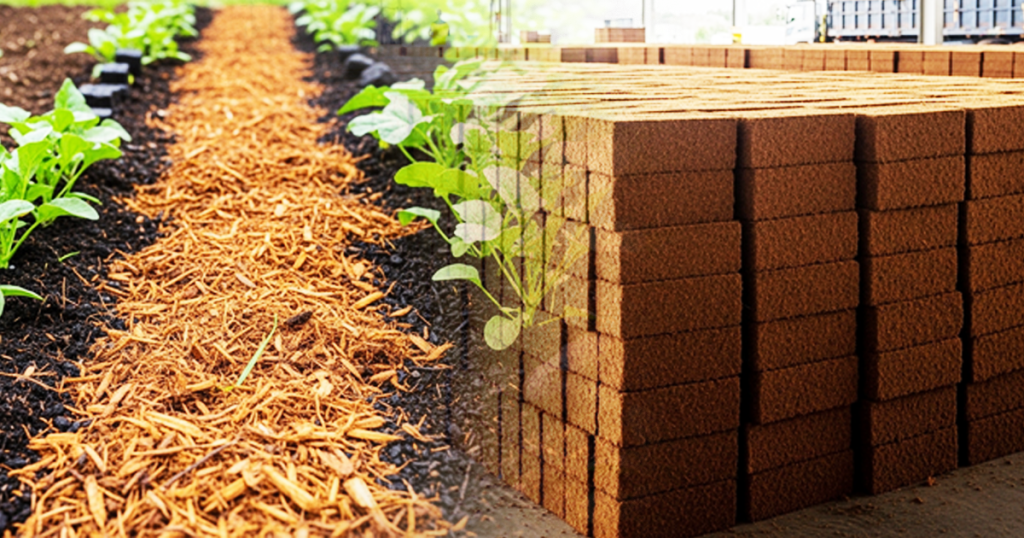
The production process begins with soaking coconut husks in water for several months to soften the fibers. The pith is then separated, washed, dried, and compressed into compact bricks. These bricks are lightweight, easy to store, and expand rapidly upon hydration.
Laboratory analysis reveals that properly processed coco peat maintains a neutral pH range (5.8–6.5) and contains trace elements beneficial to plant growth, such as potassium, iron, and zinc. Its cation exchange capacity (CEC) allows it to hold onto nutrients, slowly releasing them to plant roots.
Application and Performance in Hydroponic Systems
Coco peat bricks can be integrated into various hydroponic setups NFT (Nutrient Film Technique), DWC (Deep Water Culture), and especially drip irrigation systems. Once hydrated and fluffed, the bricks are placed in containers or grow bags where they provide stable support for seedlings.
Trials conducted in controlled environments show that plants grown in coco peat exhibit faster growth rates, increased root biomass, and higher resistance to fungal infections compared to traditional soil-based systems. This is attributed to the medium’s sterile nature and optimal balance between water retention and drainage.
Environmental and Economic Benefits
From a sustainability standpoint, coco peat checks many boxes. It reuses coconut husks that would otherwise go to waste, reduces dependency on peat moss harvested from fragile bogs, and can be reused after sterilization. Moreover, its affordability and global availability make it especially attractive for developing nations seeking cost-effective agricultural solutions.
In commercial hydroponics, the use of coco peat bricks has helped reduce operational costs by minimizing fertilizer runoff and decreasing the frequency of irrigation. This aligns with the broader trend of precision agriculture and resource conservation.
Challenges and Research Directions
Despite its many advantages, coco peat is not without challenges. High levels of sodium and potassium in untreated coir can inhibit plant growth. Therefore, proper washing and buffering are essential to remove excess salts.
Ongoing research focuses on enhancing the microbiological profile of coco peat by inoculating it with beneficial microbes. These efforts aim to transform coco peat from a passive substrate into an active growing medium that supports plant health and nutrient uptake.
Furthermore, standardizing quality across suppliers remains a key concern. Variability in particle size, pH, and EC (electrical conductivity) can significantly impact performance. As such, researchers and manufacturers must collaborate to establish uniform benchmarks and processing protocols.
The Future Looks Bright for Coco Peat Bricks
As hydroponic farming continues to rise in prominence amid global concerns over land use and water scarcity, coco peat bricks will likely play an even more significant role. Their ability to combine environmental sustainability with high agronomic performance makes them indispensable for future food systems.
From a research perspective, coco peat is more than a medium it’s a testament to how innovation can breathe new life into agricultural byproducts. As growers, researchers, and policymakers turn their focus to sustainable cultivation, coco peat bricks deserve recognition as a true hero of modern hydroponics.